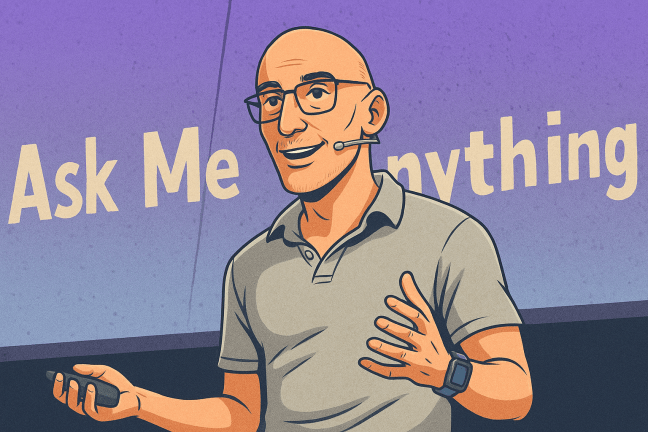
The Agile On The Beach replays are live! Since speaking, I’ve had time to reflect on what’s changed, what I got wrong, and how fast AI-first software engineering is evolving. The replay of my AI at Collecting Cars AMA is here…
What I Got Wrong
On stage, I implied I didn’t trust or use agents. I meant outside the context of an IDE, CLI based; Claude Code and OpenAI Codex. Inside Cursor we were already using agents. I could just be old fashioned and biased, but the further I get from the code, the less comfortable I am.
Since that talk, two AI-assisted bugs made it to production. The first was a flame emoji that appeared during the bid flow, an artefact from an experiment to add more drama to the bidding experience. The second was a regex change that blocked certain US phone numbers on signup. It passed all our automated tests but failed in production due to limited test coverage for international formats. They broke my claim of zero AI bugs in production, which is probably for the best. It’s a humbling and healthy reminder that trust in agents doesn’t mean removing accountability.
I was also a bit jaded about AI outside engineering. After the conference, at the boat party, I spoke with Tim Beattie from Stellafai, who asked about other departments developing with AI. It reminded me how valuable these conversations are beyond code: from shaping ideas to improving collaboration. I should have asked more questions rather than dismissing this. Stellafai’s whole team are shipping v0 products to production with great success.
AI-Augmented Engineering in Practice
At Cognito, as at TCG, we’re using AI in our daily workflows across the business.
Cursor is still my favourite IDE. Planning Mode, in particular, has been a game changer. Feed it a well-written Jira ticket (via Atlassian MCP) or prompt and it will map out the files, dependencies, and diffs before writing a line. It’s structured collaboration, not just code completion. We’ve also started running informal AI Afternoons, reviewing how we use Cursor, new techniques, sharing rules & commands, and encouraging everyone to experiment and learn. It’s been great for building a shared foundation and way of working.
Before leaving TCG, we had good results with Bugbot, Cursor’s in-house agent that scans code and pull requests for potential issues, fixing many of them automatically. Around half of its suggested fixes were merged, the rest were ignored after review. Even so, it saved roughly a developer week each month and reduced the number of bugs reaching production. While those avoided bugs were typically minor in impact, the efficiency gain was still impressive. For the cost, Bugbot represented good value, though we’re also exploring other options like Aikido and Snyk that combine quality and security insights.
How Fast It’s Moving
The landscape continues to accelerate. Anthropic recently demonstrated 30 hours of continuous coding with the release of Claude Sonnet 4.5. That’s no longer speculative. It’s here. Combine that with the rise of MCP (Model Context Protocol), and you start to see how interconnected, tool-aware AI systems are forming. They’re becoming less like assistants and more like distributed teams.
Is it time to let go of my IDE? Claude Code’s skills and subagents are alluring. I can define personas such as a senior backend engineer who cares about observability or a front-end dev focused on accessibility, and they’ll hold that context across tasks. It feels like pairing with people who have strong opinions and, in some cases, good taste. And, OpenAI Codex approach to local and spinning up Cloud agents for multiple variations of the same tasks is effective for proof of concepts. They’re good for fast experiments and new technology spikes, exploring options and learning.
For now, I still feel more productive in Cursor. I prefer using Planning Mode and staying close to the code. The balance between control and automation feels right, but the reality of being the bottleneck is looming.
Boris Cherny, one of the minds behind Claude Code, put it well: “the code is no longer precious”. His point is that our value isn’t in typing. It’s in deciding what should exist, reviewing direction, and ensuring quality. I agree, mostly. But still find the code precious because it represents decisions and trade-offs that we’re accountable for.
So where does that leave us? Somewhere between augmentation and automation. For now, I’m doubling down on augmentation, using AI to reward experience, not replace it.
And, as if to prove a point, whilst near a final draft of this post, Cursor 2.0 was released… Anysphere have found a great balance for AI-augmented engineering. I can toggle instantly between the agent view and the editor with CMD + E, staying close to the code when I need to. The new integration with worktrees and virtual container management makes switching contexts and environments seamless. Running models against each other has already become routine, allowing for quick experimentation and throwaway code when needed. More than one model resolving the same prompt means throwaway code is inevitable, but it still challenges my core beliefs as an engineer. Additionally and appropriately given it’s Halloween release, the agent controlled @Browser is spooky and powerful!
Practical Takeaways
- Use plan mode! Start with a clear Jira ticket and a good prompt
- Run your prompts through multiple models to improve their effectiveness. I write in ChatGPT, then ask Grok to critique, before sending to Cursor Plan mode
- Use AI Socratically, not as an oracle. Use it to question your assumptions
- Build scaffolding early: linting, tests, standards, docs. The payoff compounds
- Stay in the loop. You still own the diff
- Consider using AI like a team you manage. You set context, review output, and guide direction. With multiple agents, think about how they collaborate and when to run them locally versus in the cloud, depending on performance, cost, and context
- Share knowledge. Tools are easy. Culture takes work
- Subscribe to Lee Robinson on Cursor’s YouTube channel. Leerob consistently produces excellent content on Cursor and AI-augmented engineering. His tutorials and walkthroughs are practical, insightful, and a great way to stay current with the latest developments.
Closing Thoughts
Writing the code is not the point. It’s a mechanism to translate thinking into instructions a computer can act on. At the pace AI now allows us to move, the quality of that thinking matters more than ever. Architecture, intent, and consistency have become the real differentiators. In a team setting, a shared approach isn’t just helpful. It’s critical to unlocking the gains and leverage.
Leverage itself isn’t good or bad. It simply means getting more done. If that effort isn’t focused on the right things, you’re just compounding mistakes faster. When it is, the impact can be incredible. And as for what right means, for now at least, that’s still up to us…
Thank You
Thanks to Toby Parkins and Steve Smith for the opportunity and to everyone at Agile on the Beach for making it such a great event. I’ve been invited back for 2026 and can’t wait! The call for 2026 proposals is now open.
 Olly Brand