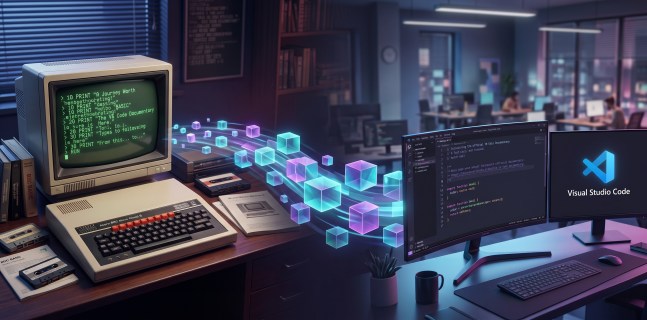
Visual Studio Code changed the game for me, and this documentary feels like a fitting tribute to it:
My programming journey started in a BBC Micro at school. Then, out of necessity to play early PC games, I became proficient at editing CONFIG.SYS and AUTOEXEC.BAT. If that sentence means nothing to you, look up 640K and MS-DOS conventional memory. Truly a golden age of computing…
My first proper taste of an IDE came with Borland Delphi and Pascal. From there I progressed, or regressed depending on your point of view, to writing HTML and JavaScript in Notepad, alongside using Visual Basic IDE.
At university, things got more eclectic. We (my fellow integrated degree scheme colleagues) used a combination of Vim, IBM VisualAge for Smalltalk and IBM VisualAge for Java. For C and C++, we stuck with Notepad. Looking back, I have absolutely no idea why we tortured ourselves like this, as if C and C++ weren’t hard enough…
Then came Eclipse
Eclipse was a big moment. IBM wanted a single extensible development platform rather than lots of incompatible internal tools. VisualAge stored code in its own repository rather than ordinary files and wasn’t particularly easy for third parties to extend. The architecture was rebuilt around an extensible, plugin-based Java workbench. That work became Eclipse and Open Source.
From there, I spent years using a combination of Eclipse, WebSphere Studio (IBM branded Eclipse) and, eventually, Rational Application Developer. RAD by name and, depending on which version you were using, not always rad by nature. They were tools. Capable tools. I loved coding and building things, and IDEs made me more effective. But the IDE was something I used rather than something I enjoyed using.

Then I found Atom
I lost my programming way during the late 2000s and early 2010s. Most of my coding became shell scripts or JavaScript embedded inside data applications while I worked on and supported data warehouses. There was the occasional Java utility or side quest to automate a process, but programming was no longer the centre of my day job.
However, IBM passionately preached was that learning and self-development were essential to a successful career. I felt I’d largely mastered the tools I needed for my role, so I started dabbling with Python. That was when I found Atom, the code editor from GitHub. It was a pleasure to use. More than that, it was pretty. I wanted to spend time in it!
That sounds superficial, but it changed something for me. Until then, my IDEs had been purely functional. Atom was the first code editor I enjoyed using. It added to the experience beyond making me more productive. For the first time, I found myself watching videos of other developers’ setups on YouTube, looking to glean hints and tips. And regularly getting myself nerd-sniped. Hard. I’d pull at threads, install plugins, tweak configurations and invest time experimenting with my setup. Sharpening the axe. It was fun!
And then VS Code happened
In 2018, as I’ve written about in The Pivot, I was given the opportunity to build a cloud-native application from scratch. By then I had loved Atom, but fallen for the charms of its new stepbrother, Visual Studio Code. Microsoft acquired GitHub, and Atom with it, in 2018. At that point VS Code was rapidly becoming something special. From the first time I used it, it became my favourite development environment. It took much of what I’d loved about Atom and needed less tinkering to get a complete workflow: an integrated debugger, terminal and Git tooling, alongside a thriving ecosystem of extensions. It somehow felt rock solid and fast, both impressive achievements for an Electron application.
Even more than Atom, it felt like something built by developers, for developers. There was an even bigger and more awesome community around it. Twitter was full of people sharing extensions, shortcuts and tricks. YouTube had an ever-growing collection of setup videos. The extension ecosystem exploded. Naturally, this provided even more opportunities for me to nerd-snipe myself. The axe was sharp! VS Code garnered an almost cult-like following, and I was happily swept up in it.
A fitting tribute
That’s why I enjoyed this documentary so much. For me, VS Code sits at an interesting point in the history of development tooling. My journey went from editing files because that was simply how you programmed, through increasingly powerful but often rather utilitarian IDEs, to editors that made the environment itself part of the joy of writing software.
Now it feels we’re at another inflection point. AI agents don’t care what editor you’re using. More coding is happening through prompts, terminals and agents. The IDE isn’t necessarily the centre of software development. Which makes the timing of this documentary particularly interesting. Maybe VS Code represents the peak of the IDE. Or perhaps, as it has done repeatedly already, it will just evolve again. Cursor being my favourite fork so far.
Either way, this documentary feels like a fitting tribute to a piece of software that genuinely changed how I experienced writing code. And it’s a great nerd watch.
How did you fare on your own journey through development tooling? What did you grow up using? What’s your IDE or editor of choice?
Has AI changed your relationship with your IDE completely? Or are you still carefully tweaking your VS Code setup while an agent does most of the actual typing?
And, where do you sit on VS Code itself? Love it or hate it? It always seemed Marmite like. There don’t appear to be many middling opinions.


My own setup used Vim for years before switching to VS Code. A single missing key in that early setup made a huge difference.
Vim felt like a tightrope. I am in awe of people who use it as autonomously as breathing.