
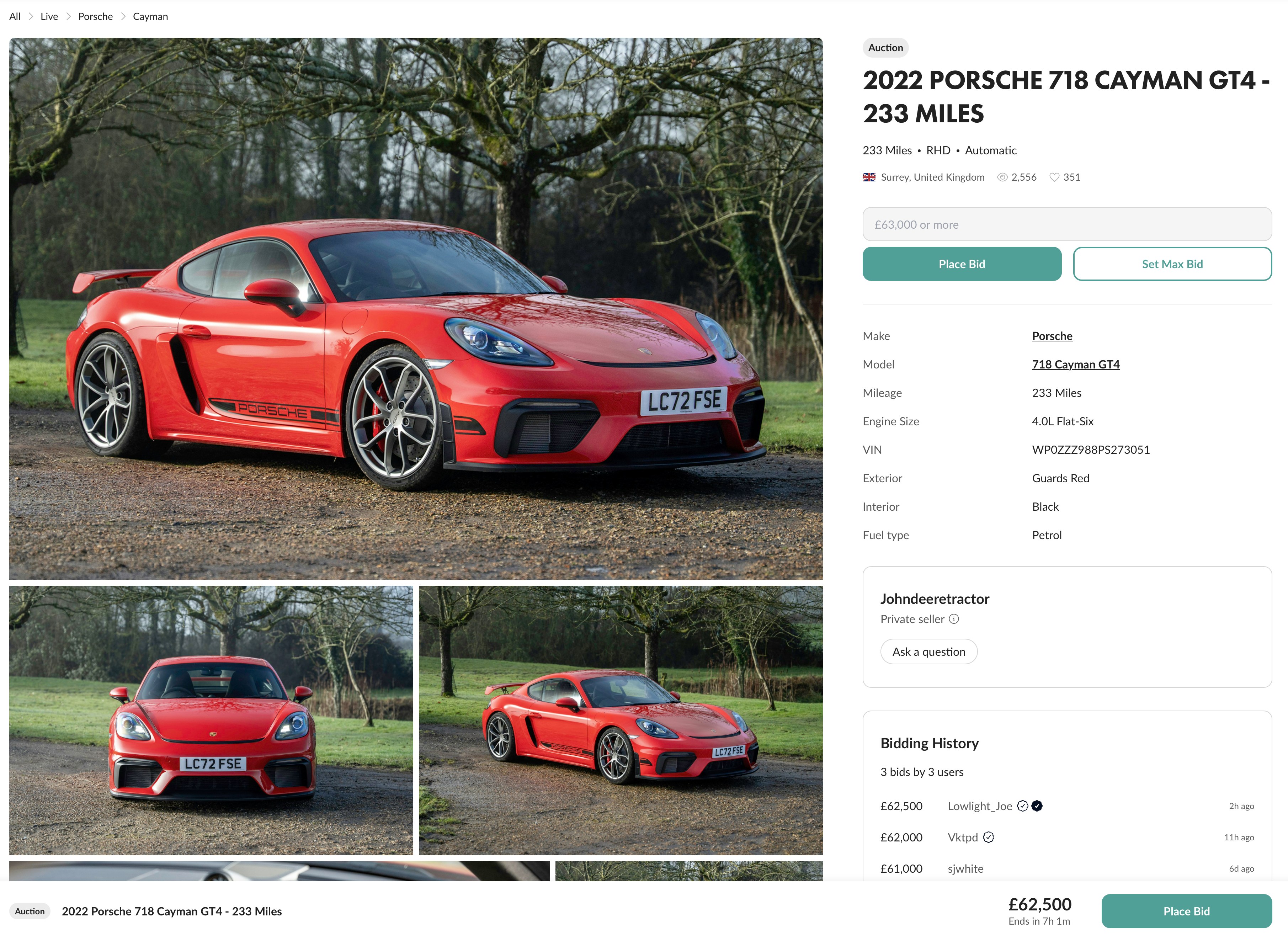
This week we released PDPv2. Our NextJS Product Display Page. The show me the money page!
You can see it for yourself on Collecting Cars and Watch Collecting.
The most critical page on the platform. The page where excitement peaks, auctions end, bids fly in, and reliability matters most. If this page fails, we lose revenue, reputation, and trust in real time.
So, no pressure then!
The scale of this migration was significant. We moved the most complex and business critical parts of the platform to Next.js whilst redesigning and modernising the experience at the same time.
This page has to do a lot:
- Perform flawlessly during auction close when traffic and demand spike
- Work consistently across a huge range of devices and network conditions
- Deliver live auction drama and excitement
- Showcase cars and watches beautifully through enhanced imagery and design
- Support bidding flows where reliability is absolutely non-negotiable
The results so far have been encouraging:
- Lighthouse scores moved from roughly 60 to 95+
- Significant SEO improvements to support organic growth
- Faster and smoother user experience
- A much stronger platform for future experimentation and iteration
- 0 lost bids
- 0 logged or reported production errors after release
Given the scale and risk profile of this migration, the team invested heavily in testing, planning, observability, rollout strategy, and rollback preparation.
A massive thank you to Matthew Barlow and Dan McLaughlin for leading this effort. Matt as the DRI and lead engineer. Dan driving delivery across an incredibly challenging programme of work. This genuinely was one of those projects where leadership, communication, and engineering quality all had to align.
We also partnered with HabileLabs to support the effort. Naman Jangid and Kajal were excellent senior engineers throughout the project and played a huge part in helping us successfully deliver this. It’s been ace working together and I’ve no doubt the outcome would have been very different without their contribution.
The biggest reflection for me: This kind of “big bang” delivery needs to become the exception, not the norm.
Because of the underlying tech migration, this project needed to be delivered in a much larger “big bang” release. This reinforced how important small, iterative delivery has become. Especially in the era of agentic engineering and AI-assisted development.
Smaller increments:
- Get value to users faster
- Reduce coordination overhead
- Improve flow for engineers
- Lower delivery risk
- Make quality easier to maintain
- Keep teams aligned and focused
“Stop starting and start finishing!”
Ironically, AI has made this even more important. The temptation is to do more because teams can suddenly move faster. But faster output without tighter focus just creates bigger queues, more fragmentation, and more operational drag.
Running a large parallel programme alongside normal sprint delivery also split one of our squads for an extended period. Unsurprisingly, that introduced friction and reduced sync across the group. Another reminder that team topology and flow matter just as much as technical architecture.
I’m looking forward to regrouping the team, focusing on that rhythm, and smaller, faster, more iterative delivery cycles.
Still. Moments like this are special!
Huge risk. Huge pressure. Huge teamwork.
And thankfully, a successful landing.


One thought on “PDPv2 “The Money Page” Released”